Extraordinary Attorney Woo · Episode 9
Extraordinary Attorney Woo Episode 9 Recap
Plot summary (spoilers)Tap to reveal the main plot lines of this episode recap
- Bang Gu-ppong, who calls himself Commander-in-Chief of the Children's Liberation Army, hijacks his mother's academy bus and takes 12 children to a mountain to play.
- Young-woo and Jun-ho learn that the children study in locked classes until 10 p.m., and the parents sign letters of non-punishment only after the academy director begs them.
- In court, Young-woo argues that Gu-ppong is a political offender rather than a deluded man, and he tells the judge he feels no remorse.
- The children attend Gu-ppong's final statement and recite his declaration in the courtroom.
- Young-woo tries being nice to Jun-ho and tells him again that she likes him, and Jun-ho finally says he likes her too.
- Late at night, Tae Su-mi comes to Gwang-ho's gimbap shop while a man watching her names Young-woo, the Hanbada attorney.
A hijacked academy bus
On a bus bound for Mujin Academy, a private cram school (hagwon), a young man tells the schoolchildren that he, the Commander-in-Chief of the Children's Liberation Army, has taken it over. His name is Bang Gu-ppong, which the children hear as Mr. Fart, and he shows his resident registration card to prove it. Any child who wants the academy should get off, he says, and no one may ask their mom. He proclaims the army's three articles: children must play, be healthy and be happy, immediately. The children clamor to drive.
At Seoul Central District Court, Woo Young-woo arrives for the arrest warrant hearing on a case she has only just taken, and Lee Jun-ho brings her the files. The 26-year-old defendant hijacked the bus two days ago and took 12 elementary school children to a nearby mountain. They played there for about four hours, and he was arrested after the bus driver reported it. The client who hired the law firm Hanbada is the academy's director, his mother. Before Young-woo goes in, Jun-ho picks an eyelash off her face.

Gu-ppong tells her he does not need a lawyer. When she worries that his name may put off the judge, he answers that children laugh at it, while her palindrome name would not make any child laugh. He offers Woodpecker's Booger as a funnier option. A name that amuses children and angers adults, he explains, is the revolution he is starting.
Before the judge, he says he changed his name legally two years ago. Asked his occupation, he says Commander-in-Chief of the Children's Liberation Army, and Young-woo blurts out an objection in the middle of the arraignment. She apologizes and coaches him to call himself unemployed. He does, then asks the judge not to write it down and repeats his title.
The director's plea and a plan to be nice
Senior attorney Jung Myung-seok and Young-woo tell the director, Choi Seong-suk, that her son has been detained; asked his address, he said he lives in children's hearts. All 12 children have quit the academy. Myung-seok advises that letters of non-punishment from the parents could reduce the sentence, even if they ask for settlement money. The director raised three sons alone, sent all three to Seoul National University (SNU) and built her academy on that experience. She begs them to keep her son out of prison.
At the pub where her friend Dong Geu-ra-mi works, Young-woo eats gimbap (rice and fillings rolled in seaweed) and reports that she told Jun-ho she likes him. He began to answer, but they had to chase a man who ran off, and he has said nothing since. Geu-ra-mi is sure he likes her, especially once she hears about the eyelash. Asking again is ruled out; Young-woo should instead be so nice to him that he gets confused. The pub owner, whom they call Hairy, explains how: pull out their seat, open the car door, let them walk on the sidewalk's inner side and carry their things.
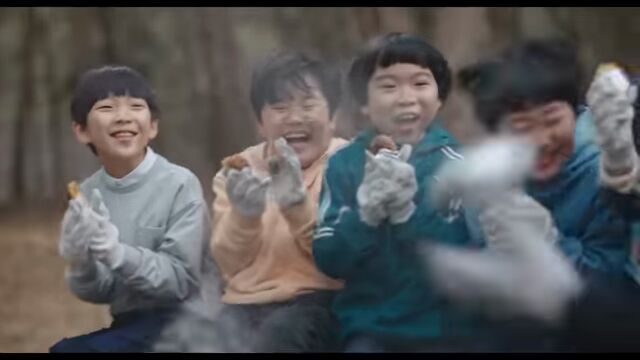
At the detention center, Gu-ppong objects to calling the children minors or victims, so Young-woo settles on children. He describes the mountain: an enlistment ceremony where he named schools, academies and parents as the enemies of Korea's children, a boy named Lee Se-won agreeing first, then rounds of red light, green light, hot snacks and milk. Play does not need to be original, he says; a child laughing at the clouds is playing. His mother wants a reduced sentence; he wants children's liberation.
Young-woo talks so much about Mr. Bang that she is told she has not mentioned whales once. He is even stranger than she is, she says, so it is nice to be with him. In the cafeteria, she pulls out Jun-ho's chair because he is holding a tray, and offers him her pickled radish.
A pied piper on trial
At the first trial session, the bus driver testifies that he drank misugaru, a roasted-grain drink, and woke four hours later at the foot of the mountain. While he was talking to the police, the defendant came down with the children behind him, "like some sort of pied piper." The defense's objection to the driver's speculation is sustained, but when Young-woo objects again, Gu-ppong says he has no objection. He admits he visited the academy for the bus schedule and spiked the misugaru with sleeping pills, and apologizes to the driver.

They hear that the director has not received a single letter, and the parents plan a class action against the academy. Young-woo thinks the children may remember the day as fun and persuade their parents. Myung-seok doubts she can meet them casually and sends Jun-ho with her. On the street, she has him walk on the inside, and at the taxi, she holds the door for him.
In the academy district after 9 p.m., a third-grader named Kim Min-ji tells them about Mujin's locked classes: no going out until 10 p.m., no breaks and permission needed for the bathroom. At a convenience store, a clerk describes children who eat instant food after 10 p.m. and choose drinks by their caffeine. Two boys show off crafts made from acorns picked on the mountain. One has been crying because he was marked undecided for not finishing a math mission that ran from 3 to 10 p.m. A boy says he does not want Mr. Bang jailed, but Se-won is called away before he can say whether he would play with him again.

Young-woo tells Myung-seok the children are like dolphins kept in small tanks, and suggests arguing that Gu-ppong rescued abused children, or that they consented. Myung-seok rejects both. Motive does not matter in kidnapping minors, and children's consent needs their guardians' too. He feels for the defendant as well, but warns her not to be swept up by his strange logic.
Choi Su-yeon, off to a blind date, asks Kwon Min-woo to introduce her to someone nice. Young-woo describes a man who pulls out seats, opens car doors, keeps you on the inside of the street, carries your things and makes good gimbap.
The letters, and a defense the client wants
At a meeting with the parents, one says the defendant could have become a rapist. Hanbada offers an apology and settlement in place of a lawsuit, but the parents are angry that Gu-ppong treated them like shameless parents at the police station. The director pleads that her son is mentally unwell and lacking, too fragile for prison, and might do something unthinkable there. In the end, all 11 letters are signed and sealed. Afterwards, Young-woo tells the director she does not see him that way; his mother should listen to him with an open heart. The children understand Mr. Bang, she says; only adults do not. A flashback returns to Se-won saying he wants to play every day and be liberated.
At the next session, a psychiatrist called by the defense diagnoses Gu-ppong with a delusional disorder, specifically megalomania. When the questioning seems over, Young-woo asks more. She describes the locked classes, children sent home for using the bathroom more than twice a day and parents signing forms that allow punishment, and asks whether his view of reality is really distorted enough to be a delusion. Myung-seok tries to stop her. The director asks him to let her continue and points to her son's face.
The judge asks why the defense is drawing out testimony against its own client. Young-woo answers that Gu-ppong is a political offender who challenged the social system, and that calling him deluded would insult his ideology, which she means to defend. The judge replies that the trial is about crimes, and asks Gu-ppong directly whether he feels remorse. Myung-seok tries to remind him of his right not to answer. "I do not feel remorse," he says, and he would do it again.
Afterwards, Min-woo asks Myung-seok to penalize Young-woo for ruining the trial. Myung-seok asks whether that love of penalties is why Min-woo wrote the bulletin-board post. Disagreements at work are talked out, he says, not punished.
The Children's Liberation Army comes to court
The attorneys apologize to the director for the split over strategy, and at the detention center Gu-ppong hears that his mother understood. The letters help, but his lack of remorse counts against him, and probation is a long shot. Gu-ppong asks them to bring the Children's Liberation Army to his final statement, so the children see him punished with dignity rather than remember prison as the price of playing.
To win over Min-ji's mother, one of the attorneys mentions that he went to SNU and passed the bar before graduating, and that Young-woo graduated summa cum laude from SNU and its law school. Watching a trial, they suggest, will make Min-ji dream of SNU, and the attorneys will chaperone. The director lends them the academy bus. When Young-woo insists on carrying Jun-ho's things, he asks why she is being so nice to him. She says it is because she likes him.
On the bus, the Hanbada team trade silly names with the children: Jun-ho is Lee Butthole, Young-woo is Woodpecker's Booger, Min-woo is Kwon Poop and Myung-seok is Jung Fart-fart.
In court, Gu-ppong tells the adults raising children that children must play now, because later is too late. The children begin reciting the declaration with him, and the judge orders silence. Young-woo points out that the children are the victims, who may state their opinion with the court's permission, and asks that the recital count as that statement. The children finish the declaration, crowd around Gu-ppong with what they have brought, and they all hug.
Over jjajangmyeon, noodles in black-bean sauce, a colleague asks Jun-ho who he likes, if it is not Su-yeon. Jun-ho says he is scared of what comes after liking each other, and that he cannot start something with her thinking it might not last. Told to go, he gets up and leaves.
Later, Young-woo counts one, two, three, the waltz count Jun-ho once gave her, and stumbles over it. She thanks him. Then Jun-ho says he has something to tell her. "I like you so much that it feels like I'm sick inside."
That night, the gimbap shop run by Young-woo's father, Woo Gwang-ho, is closed when Tae Su-mi asks to come in. A man watching notes that she has come alone, without a secretary, at this hour. Then he says Woo Young-woo's name and asks whether she is that Hanbada attorney.
Previous: Extraordinary Attorney Woo Episode 8 recap. See every episode in the Extraordinary Attorney Woo episode guide.