The Blue Road · Episode 1
The Blue Road Episode 1 Recap
Plot summary (spoilers)Tap to reveal the main plot lines of this episode recap
- A young woman is found dead in an abandoned Shinjuku building, her limbs broken and a message in Korean written in blood at the scene.
- Inose chases a man with a camera away from the scene, and the man turns out to be Kim Seok, a detective from Seoul.
- Kim Seok links the case to the murder of Park In-gyu in Korea, a body twisted the same way with Speed K in the blood, and the two detectives are paired up.
- The victim is identified as Miyashita Aki, and the dealer Takahashi Shoma points the detectives to a killer known as the photographer.
- The photographer, Kim Chang-tae, is already in prison and tells them about bodies with twisted limbs from long ago.
- Kim Seok tells Inose that bodies like these were found in Korea in the 1980s and that the killer has returned.
A body in an abandoned Shinjuku building
Over a caption reading Tokyo, a voice cries out for Mom and Dad and begs someone to stop. Inose Hiroshi is a detective with the Tokyo Metropolitan Police Department. A plaque records his first place in a junior high boys' high jump, and a phone call reports a murder in Shinjuku. At the cordon, a detective who has forgotten his badge talks his way past a uniformed officer, then scolds the officer for not checking his ID.
The scene is a building left abandoned after a fire that killed many people two years earlier. Officers from a nearby station found the body after a call, and no one has been able to reach the caller since. At the scene, a message in Hangeul, the Korean alphabet, is written in blood, and an expert is on the way to read it. In English it reads "One fear breeds infinite fear and all methods shall be concealed." The victim is a woman in her teens or twenties who has been dead for at least 24 hours.
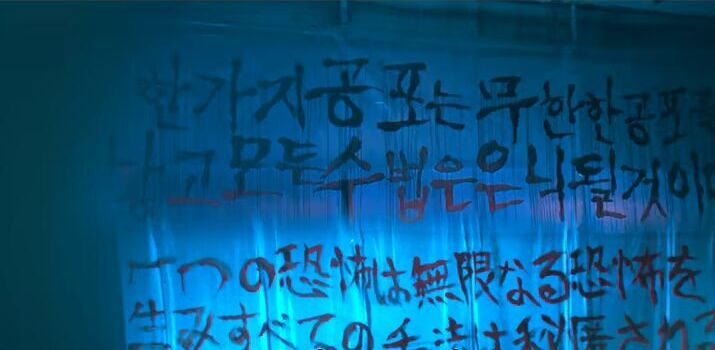
There is no sign of sexual assault, but at least 100 milligrams of drugs are in her system. Her limbs were broken before she died, apparently with some kind of tool. Vomit at the scene seems to hold bean sprouts and kimchi or yakiniku, Japanese grilled meat, and it goes to forensics. The officers plan to ask nearby stores, homeless people and local drug users, on the theory that users called in the body and ran.
Near the cordon, Inose Hiroshi stops a man carrying a camera and asks to take a look at it. When an officer moves to search the man's bag, he breaks free and runs. Inose chases him through crowded streets and finally catches him, realizing in the struggle that the man is Korean. An officer arrives with a gun drawn and orders the man to put his hands up.
A detective from Seoul
By morning, at the Investigations Division 1 office of the Tokyo police, colleagues hear that Inose's team has pulled another all-nighter. Inose questions the handcuffed man about why he photographed the crime scene. When the man stays silent, Inose Hiroshi accuses him of killing the girl and insists he knows something. Inose's superior then walks in, addresses the man as Inspector Kim, apologizes for his subordinate's discourtesy and orders the cuffs removed. Korea has just sent an international cooperation request, and the man is an investigator from Seoul. Sagawa Fumiya is sent to set up the conference room.
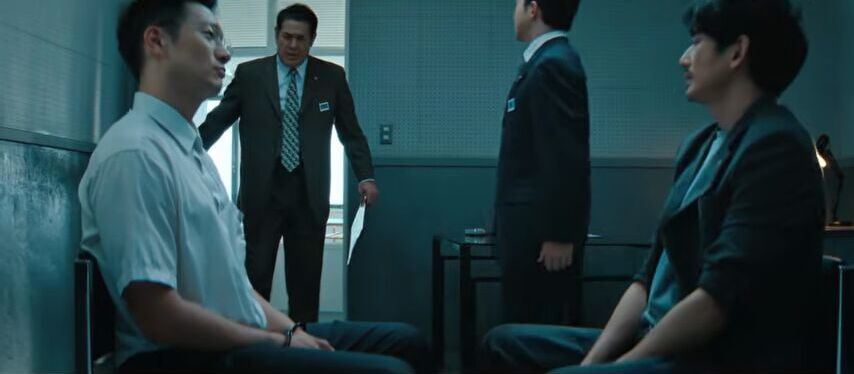
There, the man introduces himself as Detective Kim Seok of the Seoul police's Mobile Investigation Unit. Asked why he ran, he first says he wanted to see how Japanese police treat Koreans. Then he claims he was only checking the suspect's escape route. He admits he speaks some Japanese. Inose loses his temper and is told to stop.
Seok lays out a similar murder in Korea. The victim, Park In-gyu, known as Cindy, was a 38-year-old cross-dresser employed in the nightlife trade. His body was left on display like an artwork, with his joints bent the wrong way. His blood held Speed K, a new methamphetamine popular in Tokyo and spreading in Korea, where the government is watching it closely. In-gyu had visited Shinjuku to buy the drug, which is why Seok was there, and while investigating he came across a body twisted the same way.
A message written in blood was also left at In-gyu's scene, and the two messages mean the same thing. Pressed for his point, Seok explains that Korean puts spaces between words, while this phrase has none, the way Japanese is written. The Korean side has therefore identified the suspect as a Japanese national.
Tasks are handed out. Sagawa and Mikitani are to bring the forensics report, and Okamoto and Hosaka are to look for witnesses. Inose Hiroshi is put in charge of the Korean.
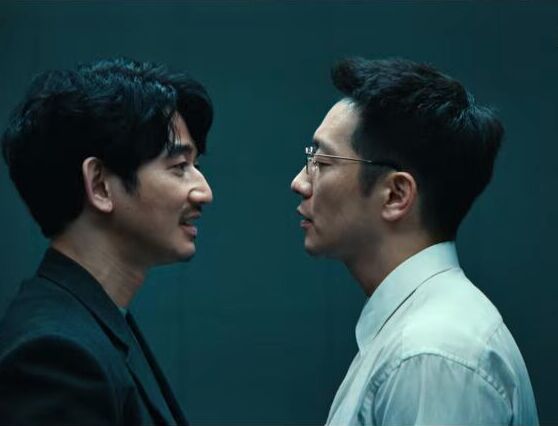
A text message says that the recipient's mother has been quite delirious lately and a visit might help. A voice calls out Seok's name and tells him not to be afraid.
A dealer named Takahashi in Kabukicho
In Kabukicho, Shinjuku's nightlife district, a group of teenagers is shown the dead girl's photo and treats it as a joke at first. Then one of them recognizes her by the mole under her eye. She is Miyashita Aki, who used to cry when drunk that she wanted to go home and missed her parents. One teenager thinks they last saw Aki the previous Saturday outside a karaoke bar with Takahashi. The group throws the questioner out once the name slips, but one of the teenagers is caught with Speed K and asked whether he bought it from Takahashi.
On a nearby street, Seok finds Takahashi Shoma, a dealer who is looking for more users to rip off. Takahashi denies knowing the man in the photo Seok shows him. When the two detectives meet up, Seok explains that In-gyu bought drugs from Takahashi in Shinjuku. Takahashi calls Akira and a gang for help, and they refuse to believe a Korean could be a police officer. The brawl that follows ends with Takahashi in handcuffs.
Accused of killing Aki and In-gyu, Takahashi is shocked to hear Aki is dead. He admits he roughed her up when she kept whining about going home to her parents, but denies killing her. Threatened with having his own limbs twisted, Takahashi realizes how Aki was found and names a suspect: "The photographer is back."
A colleague's report fills in the rest. Years ago, a rumor among street gangs described a hitman who took jobs from the yakuza and photographed the bodies afterward. His killings differed from Shinjuku: no drugs, signs of sexual assault and a different method. The police identified him during a yakuza turf war but never found a trace of him, and he was never arrested. The detectives leave Takahashi cuffed, shouting for someone to take the handcuffs off.
The photographer is Mikogami Sota, whose Korean name is Kim Chang-tae. He is a Zainichi Korean, an ethnic Korean living in Japan, and he has been missing for years. The detectives reason that a killer like him could not simply stop, so he must be dead or locked up. They wonder whether he kept his Korean nationality and is held under his Korean name instead.
Inside the Kanto Foreigners' Prison
At the Kanto Foreigners' Prison, they find Kim Chang-tae. At a remark about a blind photographer, he answers that not everything is as it seems. The detectives' theory is that he killed as Kim Chang-tae rather than Mikogami and let himself be locked up to escape the yakuza. Chang-tae guesses they came about Shinjuku and says the method resembles his own work in Ikebukuro. In his view, they took the new killer for his copycat and came for a lead, knowing he is not the culprit.
One of the detectives then tells him the Shinjuku killer is far more skilled than he is. Where Chang-tae only twisted limbs crudely, the detective says, that killer displays each victim like a work of art. The detective asks whether Chang-tae copied Shinjuku. The visit turns heated until someone calls for calm, and the theory comes out that Shinjuku is the original and came first.
Chang-tae says he cannot tell whether Shinjuku is the original. He does know that bodies with twisted limbs were found a very long time ago, though he only read about them in old newspapers and has never met that killer. He assumed the killer had been caught or had died. Chang-tae wishes the two detectives luck. On the way out, one of the detectives tells him he is just a murderer who will rot in prison.
Aki's parents and a late-night talk
Late that night, the two detectives visit Aki's parents. They offer condolences, apologize for failing to protect her and promise to catch the killer. One of her parents answers that they failed to raise her right. The parent calls her a problem child and a disgrace who ran away and took drugs, and admits to half expecting her to die this way. The apologies keep coming until one of the detectives snaps at them. Their daughter is dead and did nothing to deserve it, the detective says, and until the end she said she missed them and wanted to go home, so this is no time to apologize.
Outside, the two smoke. One of them wonders aloud what the point of catching criminals is in a world this bad. Seok asks not to be called Korean anymore, but Kim Seok or Detective Kim. The request is accepted with an apology, and the two share a light.
One of the detectives questions the account of stumbling on an identical crime scene and asks what the original is supposed to mean. Seok points to the old newspapers Kim Chang-tae mentioned. In Korea in the 1980s, a body was found with its limbs twisted, and then more followed. The case has been repeating itself for a long time, he says, and "the killer has returned."
See every episode in the The Blue Road episode guide.